GREECE
 PELOPONNESE
MESSINIA
ENGLIANOS
PALACE
PELOPONNESE
MESSINIA
ENGLIANOS
PALACE

updated: 2026-04-17
lat/lon: 37.02723°N, 21.69496°E

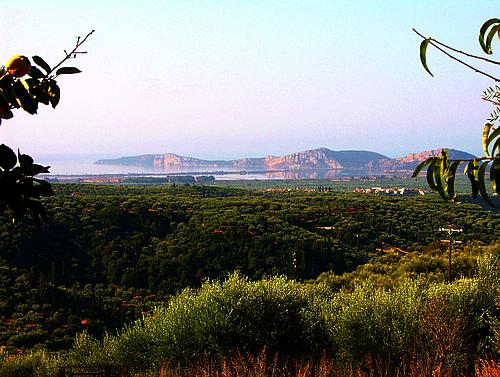

Plan of Nestor's palace
| Main building | Main building (continued) | SW building (Old Palace) |
| 1: Entrance (propylon) | 16: Wine magazine | 32: Old Palace courtyard |
| 2-3: Archive room | 17-19: Royal quarters & storage | 33: Old Palace Prodromos |
| 4: Inner courtyard | 20-21: King's quarters | 34: Old Palace megaron |
| 5: Waiting room | 22: King's anteroom | 35: Pantry |
| 6: Room for refreshments | 23: King's courtyard | 36: Bathroom |
| 7: Entrance hall (portico) | 24: Bathroom | 37: Wine magazine |
| 8: Prodomos | 25: Queen's megaron | |
| 9: Megaron (domos) | 26: Queen's courtyard | NE building |
| 10: Corridor | 27-28: Queen's quarters | 38: Sanctuary |
| 11-13: Pantry | 29-30: Palace guard | 39: Workshop |
| 14-15: Oil magazine | 31: Wine magazine | 40: Magazine |
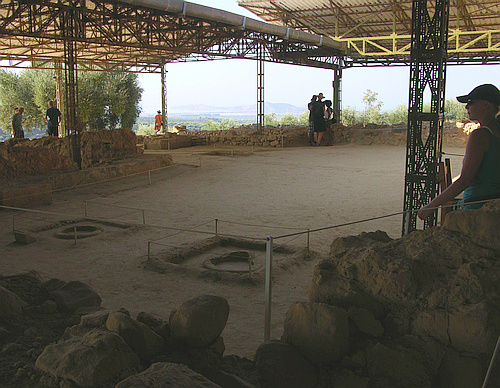

Soon after Carl Blegen had begun to dig at Ano Englianos in 1939, World War II intervened. It was not until 1952 that Blegen was able to return with a team from the University of Cincinnati and organize a thorough campaign of excavation — he was to stay for a dozen years.
Unlike Mycenae or Tiryns, the site at Ano Englianos was never fortified. It consists of 105 ground floor apartments, distributed over four main buildings (central building, SW building, NE building, wine magazine).
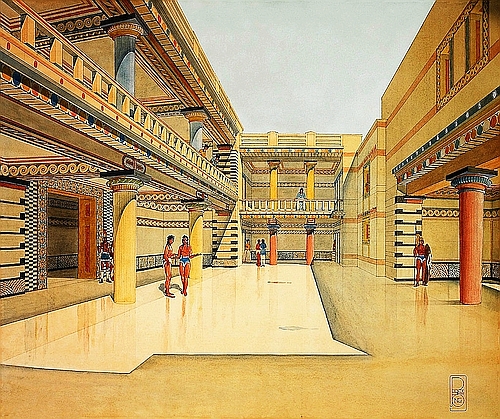
Although Nestor's palace is regarded as the best preserved of the Mycenaean palaces, it is not easy to imagine the original appearance of the buildings from the remains. In the 1966 publication of the excavation results, however, two reconstruction drawings by Piet de Jong (below) were included. Countlessly reproduced, they have decisively shaped our conception of Mycenaean palaces.


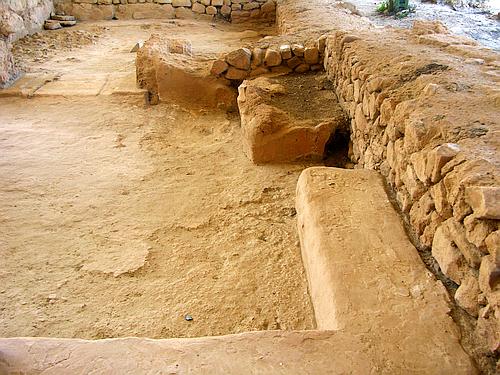
Above left: Sherds sherds from the excavations, exhibited in the museum of Chora. - Above right and below: Before entering the royal quarters in the central building, the visitor arrived at a number of courtyards and anterooms.